Product Update
One Spanish Doesn't Fit All: Why Script, Voice and Accent Matter in North American Audio Advertising
With 320+ Spanish voices, 23 accents, and a platform that adapts the script, voice, and delivery to each audience, brands, agencies, and publishers can sound like the communities they're talking to.
October 28, 2026
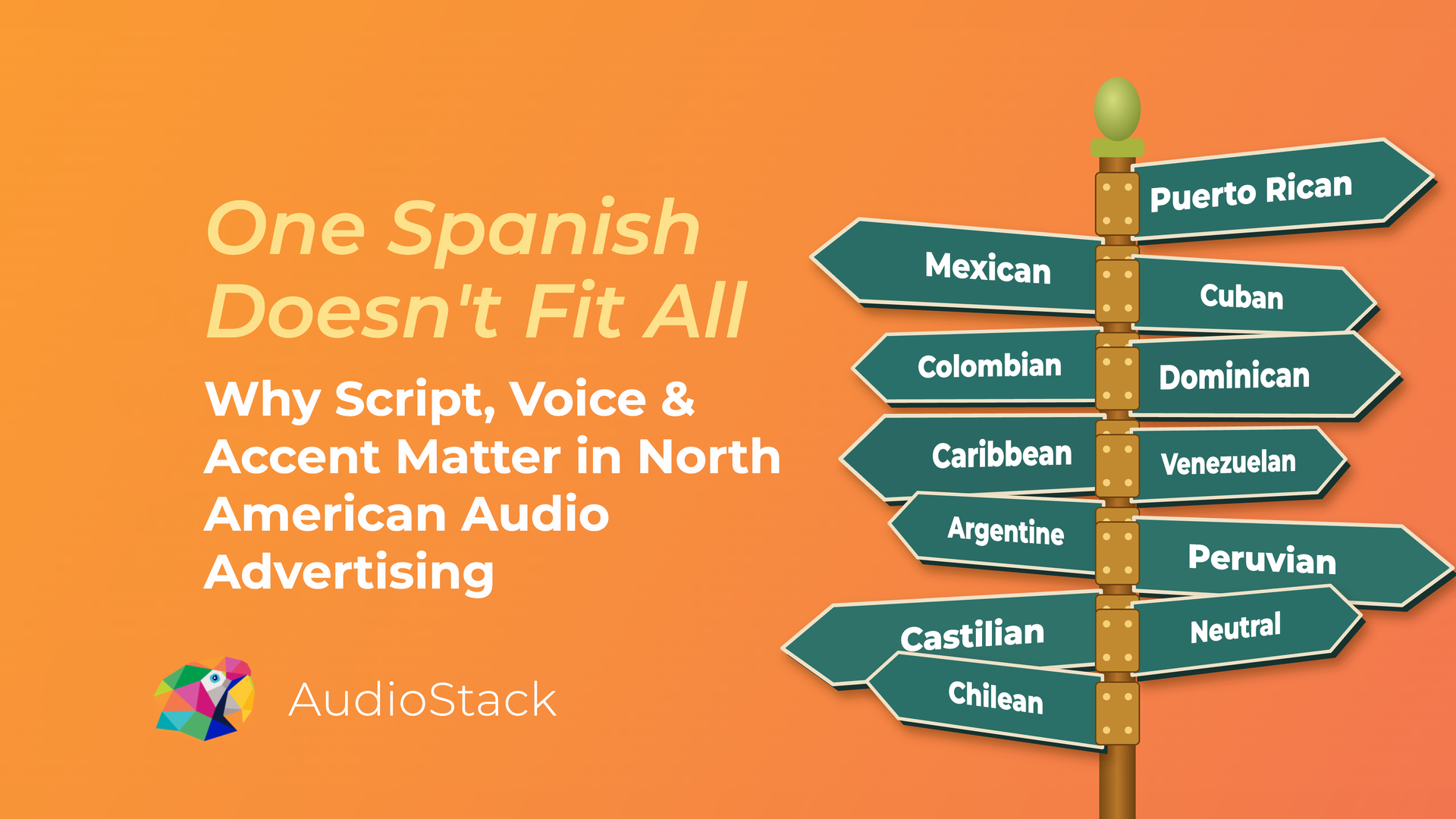
There is no single “Hispanic audience” in North America. There are more than 60 million Hispanic and Latino people in the United States alone, roughly one in five Americans, and they trace their roots to more than 20 countries. A Mexican American family in Houston, a Puerto Rican family in Orlando, and a Cuban American family in Miami may all speak Spanish. They do not all sound the same, and they notice immediately when an ad doesn't sound like them.
For years, audio advertising has treated Spanish as a checkbox: translate the English script, record it with one “neutral” voice, and call it localized. That approach leaves performance on the table across one of the biggest markets in the world. It misses two things listeners pick up on right away: how the ad is written, and how it sounds. Accent is one of the first signals a listener uses to decide, within a second or two, whether a message is for them. The words and the way they are put together decide whether they stay.
Accents are a trust signal
Think about how different the same sentence can feel depending on who says it:
•
Mexican Spanish is the most widely spoken variety in the US, and it carries distinct rhythm and vocabulary, especially across the Southwest and in states like California, New Mexico or Texas.
•
Puerto Rican Spanish is the voice of communities across Florida, New York, New Jersey and Pennsylvania, with its own cadence and expressions.
•
Cuban Spanish is closely tied to South Florida and carries a warmth and speed that listeners in Miami recognize instantly.
•
Colombian, Dominican, Salvadoran, Venezuelan and others each bring their own sound to regional communities across the country.
A voice that feels “off” doesn't just sound generic. It can read as a brand that hasn't done its homework. A voice that sounds like the listener's own community says something different: we know you, and this was made for you.
It starts with the script, not just the voice
A great accent can't rescue a script that was written for someone else. A line translated word for word from English still sounds translated, whatever voice reads it. Vocabulary, idioms, level of formality, cultural references, and even sentence rhythm shift from one community to the next, so the way an ad is produced matters as much as the voice that delivers it.
That is why AudioStack treats script writing and voice as one workflow. Our platform takes in the context of the campaign (who the audience is, where they are, what the brand needs to say) and uses it to shape the whole ad:
•
Script adapted to the audience: Copy is written or adapted for the community it is meant for, with the vocabulary, tone and references that audience uses, rather than translated from a single master script.
•
Voice chosen to match: The accent, age, tone and style of the voice are selected to fit that audience and that script, so the words and the sound reinforce each other.
•
Delivery that fits the context: Pacing, energy and emphasis adjust to the message and the moment, from a high-energy retail promotion to a calm, reassuring financial service.
The result is audio that sounds like it was made for the listener from the first word, not localized after the fact.
320+ voices, 23 accents, one platform that adapts to your audience
The AudioStack library now includes more than 320 Spanish voices across 23 distinct Spanish accents, and the platform brings script and voice together around your audience. For North American brands, agencies, and publishers, that means you can:
•
Match the accent to the right audience and location. Run Mexican Spanish voices in Southern California, Puerto Rican voices in Orlando, and Cuban voices in Miami, all from the same campaign brief, with the script adapted for each.
•
Pick the right voice for the brand. Within each accent, choose from a range of ages, tones, and styles, from upbeat retail energy to calm, trustworthy financial services.
•
Test and iterate quickly. Try different scripts, voices, and accents against the same campaign and let the data show which one resonates, instead of guessing.
•
Scale without re-recording. Producing a new version, whether that is a rewritten script or a different voice, doesn’t mean rewriting from scratch or booking a new studio session.
What hyperlocal looks like in practice
Localization at scale isn't theoretical. For a leading US home improvement retailer with around 1,700 stores, AudioStack produced more than 1,500 unique audio assets in just three days. The campaign ran for 10 days during the spring sales season, targeting 385 store locations across three flights, in both English and Spanish. It promoted appliance discounts for non-members and loyalty rewards, and was delivered through digital podcast insertion.
The approach was a hybrid. Master messages were recorded by in-house voice talent, and AI-generated location call-outs were layered in so that the script of each ad spoke directly to the listener's own area. No one had to record hundreds of store-specific versions by hand, and production that would normally take weeks was compressed into days.
The results showed what relevance is worth:
•
4% increase in incremental foot traffic
•
7% uplift in incremental sales
•
$500K in additional sales attributed to the localized messaging
This is the principle behind hyperlocal audio: the closer the message is to the listener, the better it performs. Place names and store details were the first layer, written into the script. Voice and accent are the next one. Pair a bilingual campaign with a script written for the community and an accent that matches it, and you add a second layer of familiarity on top of local relevance.
The same logic applies across North America
Hispanic communities are only one example. Wherever audiences have a distinct regional identity, the script and the voice should reflect it.
Canada: English with a Canadian sound
Canadian English isn't American English with a different flag. It has its own sound, vocabulary and rhythm, and Canadian listeners are quick to notice when an ad sounds imported. A national retailer, bank or telecom running Canada-wide campaigns can use Canadian English scripts and voices instead of defaulting to US copy and a US accent, and make the brand feel genuinely Canadian.
French Canadian: not the same as European French
Roughly one in five Canadians speaks French as their first language, and the French spoken in Quebec differs from the French of France in accent, expressions and tone. Quebec audiences expect Québécois French, and they respond to it. Acadian communities in the Maritimes have their own distinct sound too. A Quebec script should be written for Quebec, not adapted from France-French or translated from English. Reusing a European French recording for a Quebec campaign is the audio equivalent of using the wrong currency.
And beyond
The same thinking applies to regional US English (a Southern drawl in Atlanta, a Midwestern voice in Chicago), and to the many other languages and communities that make up the North American market. The more local the script and the voice, the greater the consumer impact.
What this means for brands, agencies and publishers
•
Brands can build campaigns that reflect the communities they serve, not just the language they speak, with scripts and voices matched to each audience.
•
Agencies can offer clients real cultural precision, in both the writing and the voice, across markets without multiplying production costs and timelines.
•
Publishers can offer advertisers context-aware, accent-matched, locally relevant audio inside their inventory, which makes that inventory more valuable.
Audio is intimate. A voice in your headphones or your car feels personal, and when it sounds like someone from your own community, it lands in a way a generic voice never will.
Ready to sound local?
Explore the Spanish voices and accents in the AudioStack library, and see how a platform that adapts script and voice to your audience can lift your next campaign. Get in touch with the AudioStack team.